3D Printing in Dentistry has revolutionized clinical processes, enabling the creation of medical devices tailored to the individual patient’s anatomy. One of the key technologies in this field is Digital Light Processing (DLP), which is widely used in dentistry due to its high precision and ability to rapidly produce accurate dental models. This technology utilizes printable resins and layer-by-layer techniques to manufacture dental models, surgical tools, and various prosthetics, improving clinical outcomes and enhancing efficiency. In addition to its wide applications in dentistry, 3D DLP printing also presents some challenges, such as limitations in the variety of usable materials and the need for post-printing processing. However, ongoing research and development in this field are enhancing the capabilities of this technology and expanding its applications in various medical and dental sectors. In this article, we will provide a comprehensive review of the technical aspects of the DLP method in dentistry, its applications, advantages, disadvantages, and the ongoing research and development. Additionally, we will introduce the best and most well-known DLP printer brands.

Technical Aspects of 3D DLP Printing
3D printing with Digital Light Processing (DLP) is an additive manufacturing technology that uses a digital projector to shine light onto a vat of liquid resin. This process involves converting a digital model into a physical object through a layer-by-layer construction method.
1. Main Steps of the DLP Process
- Design Preparation: The 3D model is designed using CAD software and optimized for printing.
- Printer Preparation: Ensuring the resin vat is filled and the build platform settings are correct.
- Printing: The projector displays an image of the first layer of the 3D model onto the surface of the resin, solidifying it. The build platform continuously rises as new layers are added and cured. This process repeats until the entire object is constructed.
- Post-Processing: After printing, the piece is carefully cleaned and cured under UV light to reach its final hardness.
2. Technical Advantages of DLP
- High Speed and Efficiency: DLP can project entire layers simultaneously, making it one of the fastest 3D printing techniques, especially for large-scale production.
- High Accuracy and Resolution: DLP devices can control each pixel precisely, resulting in high-detail and accurate prints.
- Smooth Surface: DLP prints generally require less post-processing and yield a more professional-looking final result.
3. Technical Challenges of DLP
- Material Limitations: DLP printers mainly use photopolymer resins, which are generally more expensive and offer less material variety compared to other technologies like FDM.
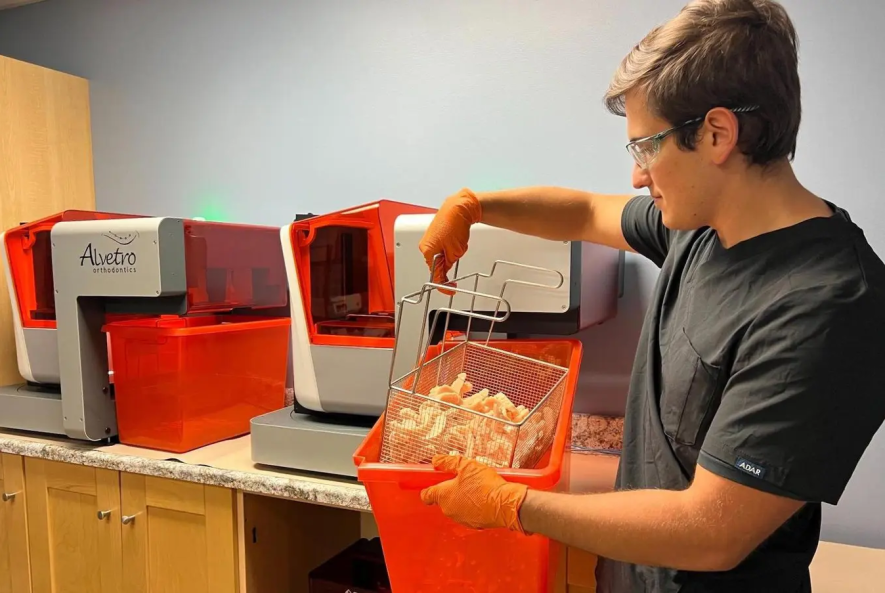
- Post-Processing Requirements: Printed parts need to be cleaned and cured before use, requiring additional time, space, and equipment.
- Limited Build Volume: DLP printers typically have smaller build volumes, which can restrict the size of objects that can be printed.

Applications of 3D DLP Printing in Dentistry
3D DLP (Digital Light Processing) printing has significantly transformed dentistry, as this technology can produce highly precise dental models and devices with intricate details. Here’s a closer look at some of the main applications of 3D DLP printing in dentistry:
- Dental Prosthetics: DLP technology is widely used to create dental prosthetics such as crowns, bridges, dentures, and inlays/onlays. The high precision of DLP printers allows for the production of complex geometries and detailed features that are essential for proper fit and function in dental restorations.
- Orthodontics: In orthodontics, DLP 3D printing is used to manufacture clear aligners and retainers. It is also employed to create orthodontic models, which are essential for treatment planning and fabricating various orthodontic devices.
- Surgical Guides and Molds: DLP 3D printing plays a crucial role in producing surgical guides that aid in the precise placement of implants and other surgical interventions. These guides are custom-made for each patient using accurate imaging techniques such as Cone Beam Computed Tomography (CBCT).
- Endodontics and Periodontics: In endodontics, DLP printers can produce tools and models that assist in root canal procedures. In periodontics, 3D printed models are useful in preparing for and performing periodontal surgeries such as gum grafts.
- Maxillofacial Surgery: DLP 3D printing is used to create custom implants, surgical models, and guides for reconstructive surgeries in maxillofacial cases. This application is critical for complex surgeries that require a detailed understanding of the patient’s anatomy.
- Educational Models: Dental education has greatly benefited from DLP 3D printing. This technology enables the creation of anatomical models for educational and training purposes, providing students and professionals with realistic simulations of dental procedures.
- Custom Devices and Appliances: One of the key advantages of DLP printing is its ability to customize dental devices and appliances for each patient. This includes everything from night guards and occlusal splints to custom trays and retainers, ensuring a perfect fit and optimal patient comfort.
Thanks to its versatility, precision, and efficiency, 3D DLP printing continues to expand its applications in dentistry. As the technology advances, its role in improving dental care and education is likely to grow further.

Ongoing Research and Developments in 3D DLP Printing for Dentistry
The field of 3D DLP (Digital Light Processing) printing in dentistry is rapidly advancing, with ongoing research and developments focused on several key areas to enhance the application and efficiency of this technology.
- Material Development: A significant portion of research is dedicated to developing new and improved dental materials for use with DLP technology. This includes creating biocompatible and durable resins that are better suited for long-term use in dental restorations. For example, researchers are investigating polymers and composites that offer greater strength and durability while reducing the need for post-processing and improving the overall aesthetics of dental prosthetics.
- Advanced Printing Techniques: Continuous efforts are being made to improve the printing techniques used in DLP 3D printing. Researchers are working on optimizing the accuracy and resolution of printed dental components by enhancing digital light projection mechanisms and refining curing processes to minimize distortions and defects. Innovations such as dynamic layer projection, where the layer thickness is adjusted in real time based on the geometry of the model, are being tested to increase precision and reduce material waste.
- Integration with Digital Dentistry: Research is also focused on better integrating DLP 3D printing with other digital dentistry technologies, such as CAD/CAM systems and intraoral scanners. This integration aims to streamline workflows from digital impressions to the fabrication of dental restorations, reducing production times and improving the accuracy of dental treatments.
- Applications in Restorative Dentistry: An emerging area of research is the application of DLP 3D printing in restorative dentistry. This includes the use of 3D-printed scaffolds made from bioactive materials to support tissue regeneration and repair. Studies are underway to evaluate the effectiveness of these scaffolds in enhancing periodontal tissue regeneration and bone regeneration for implant placement.
- Reducing Environmental Impact: Research is also being conducted to reduce the environmental impact of DLP 3D printing. This involves the development of eco-friendly resins, recycling systems for used materials, and optimizing energy consumption during the printing process.
Overall, ongoing research and developments in DLP 3D printing for dentistry are focused on improving material properties, increasing printing accuracy, integrating with digital workflows, exploring new clinical applications, and reducing environmental impact. These advancements are aimed at making DLP 3D printing a reliable, efficient, and versatile tool in dentistry.

Key Considerations Before Buying a DLP 3D Printer for Dentistry
Choosing the right DLP 3D printer for dentistry requires careful consideration of several key factors based on the specific needs and objectives of a dental clinic or laboratory. Here are some of the most important points to consider when selecting a suitable DLP printer:
- Print Quality and Accuracy: One of the most critical factors in choosing a printer is the quality and accuracy of the prints. DLP printers typically offer high accuracy due to their use of digital projector technology. However, some printers may inaccurately advertise features such as layer height, pixel size, or laser spot size as “accuracy,” which may not directly impact the final precision of printed parts. To ensure quality, it is advisable to review printed samples and use real scan data of printed parts.
- Ease of Use and Educational Support: The ease of using the printer, particularly for everyday operations and training, is essential. Many companies offer free educational resources, guides, and courses that help dental teams quickly become familiar with the latest clinical applications. Some printers come with customized software for preparing 3D models for printing, simplifying the workflow.
- Cost and Return on Investment (ROI): The cost of 3D printers can vary, but one of the important factors in choosing a printer is the total production cost and ROI. Initial purchase costs, material expenses, maintenance costs, and the need for additional equipment, such as wash and curing units, should all be considered. For many labs, using printers with automation capabilities can reduce costs and increase productivity.
- Ability to Work with Different Materials: DLP printers are compatible with various resins, each suited for specific applications. Evaluating the printer’s compatibility with different materials, including biocompatible resins and materials suitable for dental models, is crucial for selecting the best printer.
- Advanced Features and Automation: Some DLP printers offer advanced automation features that allow users to perform multiple print jobs simultaneously without continuous interaction with the printer. These features can be particularly useful for large labs that require continuous production.
Ultimately, choosing the best DLP 3D printer for dentistry depends on the specific needs of your clinic or lab, the available budget, and your printing goals. It is recommended to conduct thorough research and review printed samples before purchasing to ensure the quality and suitability of the printer for your needs.

Popular Brands and Models of 3D DLP Printers for Dentistry
Several brands are recognized as leaders in 3D DLP printing for dentistry, offering a range of models that cater to different needs and budgets. Here are some of the most well-known options:
- SprintRay Pro: Known for its high speed and large build volume (18.2 × 10.2 × 20 cm), the SprintRay Pro is ideal for producing a large number of dental models in a short time. It supports various third-party resins, including those specifically designed for dental applications like dentures and clear aligners. SprintRay Pro is also known for its ease of use and lifetime free phone support, although it is priced higher than other models.
- Asiga Max: This printer is renowned for its high precision, offering an XY resolution of 62 microns and a build volume of 119 × 67 × 75 mm. It is popular in professional environments, including dentistry, for its accuracy and reliability. It also supports an open resin system, allowing users to work with a wide variety of resins. However, its smaller build volume and higher cost may be limiting factors for some users.
- Kulzer Cara Print 4.0: Using DLP technology, this printer is designed specifically for dental applications and supports materials such as zirconium oxide and gypsum. It is lightweight and user-friendly, making it ideal for dental practices seeking a reliable and simple printer. However, Cara Print 4.0 is more expensive than many other options and may lack some of the advanced features found in newer models.
- B9 Core 550: Known for its high speed and print quality, this model offers 10-micron resolution and an XY resolution of 50 microns. It is designed for rapid production, making it suitable for dental labs needing to produce high-quality parts efficiently. The B9 Core 550 also features a durable resin vat that can handle over 1,250 prints before needing replacement, offering good value for its cost.
- Carbon M2: Utilizing Digital Light Synthesis (DLS) technology, the Carbon M2 is a professional-grade printer that supports various dental materials, including biocompatible resins. It offers automated print settings and relatively fast print speeds, though its build volume is smaller compared to some other printers on the market. This model is ideal for advanced dental applications that require high precision and efficiency.
Each of these printers has unique strengths and addresses different aspects of dental 3D printing. When choosing a printer, it’s essential to consider factors such as build volume, material compatibility, speed, and overall cost to find the best option for your specific needs in a dental practice or lab.
Conclusion
DLP 3D printing has emerged as a leading technology in dentistry, playing a crucial role in improving treatment methods and enhancing clinical outcomes. This technology enables the precise and rapid production of dental models, surgical tools, and dental prosthetics, meeting various treatment needs with high accuracy and excellent surface quality. Despite challenges such as material limitations and the need for post-printing processes, ongoing research and development are continually enhancing the capabilities and expanding the applications of DLP 3D printing. As a powerful tool in modern dentistry, DLP 3D printing will continue to advance dental care and clinical efficiency with the development of new materials, optimization of printing techniques, and integration with other digital technologies. Selecting the right printer, tailored to the specific needs of each clinic or lab, is a key factor in maximizing the productivity and success of this technology. With further progress, DLP 3D printing is expected to play an even more prominent role in the future of dentistry.