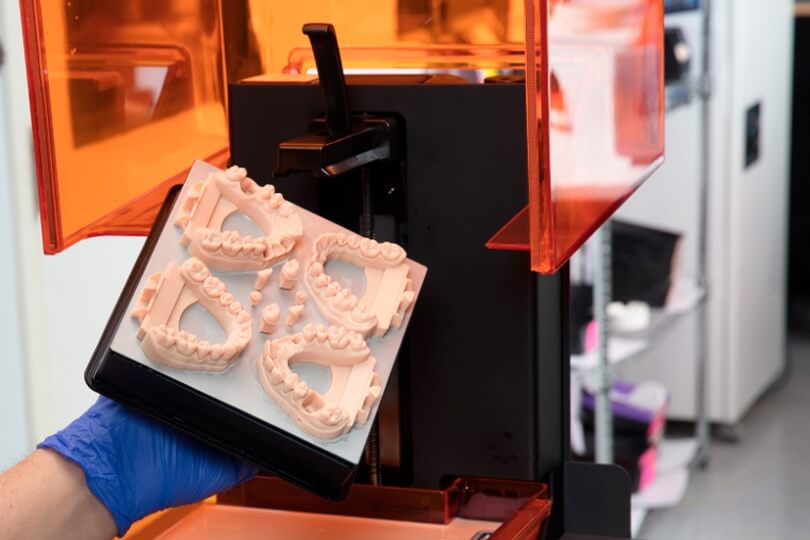
Fused Deposition Modeling (FDM) is a 3D printing technology widely used in various fields, including dentistry. In the field of dentistry, FDM enables the precise and customized production of dental models, implants, and surgical guides. This method uses thermoplastic materials and sequential layer deposition to create complex and detailed structures that improve patient treatment outcomes. Due to its efficiency, low cost, and ability to produce customized tools, this technology has gained special attention from dentists. FDM plays a significant role in the production of dental prosthetics, orthodontic models, and even biocompatible implants that are precisely aligned with the patient’s anatomy. With continuous advancements in FDM materials and printer capabilities, this technology is expected to be more widely used in everyday dental care.
Types of FDM Printers
FDM printers come in various types, each with specific features and advantages. Some of these printers include:
- Cartesian Printers: These printers operate on three axes—X, Y, and Z—and are highly effective in producing dental models and surgical guides due to their high precision and ease of use.
- Delta Printers: These printers utilize a triangular structure and offer high printing speeds, making them suitable for creating large and complex parts.
- Polar Printers: These printers work with rotational movements and are ideal for producing circular parts and symmetrical structures.
Applications of FDM Printers in Dentistry:
Each of these printers can have different applications in dentistry:
- Dental Models: Cartesian printers, due to their high precision, are very suitable for creating dental models for educational purposes or surgical planning.
- Surgical Guides: Delta printers, with their high speed, are used for the rapid production of surgical guides that are utilized in dental implants.
- Dental Prosthetics: Polar printers, with their ability to produce symmetrical and precise structures, are suitable for making dental prosthetics.

Materials and Filaments Used in FDM for Dentistry
The materials and filaments used in FDM for dentistry include the following:
- Polylactic Acid (PLA): PLA is one of the most common filaments in FDM due to its low cost, biodegradability, and ease of printing. It is particularly suitable for dental models and temporary prosthetics that do not require long-term durability.
- Acrylonitrile Butadiene Styrene (ABS): ABS is used for making precise dental models and functional parts due to its strength and high resistance to heat and impact. However, printing with ABS requires a heated bed and a well-ventilated environment.
- Polyethylene Terephthalate Glycol (PETG): PETG is ideal for dental parts that need direct contact with the body due to its good moisture resistance and sterilization capability. It is also suitable for making parts that require flexibility.
- Polyether Ether Ketone (PEEK): PEEK is an advanced and expensive material used for making dental implants and parts that require high biocompatibility due to its exceptional resistance to heat and chemicals.
- Nylon: This material is used for producing dental prosthetics and parts that require high strength and durability due to its flexibility and high resistance.

Introduction to Biomaterials in FDM 3D Printing
Biomaterials used in FDM for dentistry have numerous applications in implantology, dental restoration, and even in printing biological scaffolds for the growth of new tissues, due to their ability to create complex and customized structures. Challenges such as achieving complete biological integration and enhancing the mechanical strength of these materials remain under research and development.
Types of Biomaterials Used in FDM:
- Polyether Ether Ketone (PEEK): PEEK is one of the most widely used biomaterials in FDM due to its high chemical resistance and superior biological properties. It is used for manufacturing dental implants and prosthetic components. PEEK is considered a suitable alternative to metals in dental applications because of its strength and heat resistance.
- Hydrogels: These materials are used as biological scaffolds for the repair and regeneration of dental tissues. Hydrogels are employed in dental and surrounding tissue regeneration due to their flexibility and ability to mimic the structure of living tissues.
- Nanocomposites: Nanocomposites are used in the fabrication of dental prosthetics and implants due to their combination of mechanical and biological properties. They can improve adhesion and bonding with dental tissues.

Application of FDM in Complex and Customized Dental Prosthetics
FDM, as a 3D printing technology, enables the production of dental prosthetics with complex shapes and sizes tailored to each patient. This method allows dentists to create prosthetics with detailed precision using biocompatible materials such as PEEK and nylon. Prosthetics produced through FDM have high mechanical strength and stability due to the precise layer deposition technology, which enables them to blend well with natural dental tissues.
Key Features:
- High Customization: FDM allows the production of prosthetics that precisely match the anatomy and specific needs of each patient. This level of customization is particularly important in complex cases that require precise adaptation to dental tissues.
- Efficiency and Speed: Using FDM enables dentists to produce prosthetics quickly and with high accuracy, which helps reduce patient waiting times and improve the treatment process.
Role of FDM in Creating Diagnostic Models and Surgical Guides in Dentistry
FDM enables dentists to create precise 3D models of a patient’s oral and dental anatomy. These models, which are constructed from imaging data such as CT scans and MRIs, are used for more accurate diagnosis of dental issues and for planning complex surgeries. Due to their high precision and low cost, FDM-produced models are a suitable alternative to traditional models, allowing dentists to perform necessary simulations and evaluations before the actual procedure.
One of the key applications of FDM in dentistry is the production of surgical guides. These guides help dentists place dental implants more accurately in the correct locations. They are custom-made based on each patient’s oral structure and enhance the precision of surgical procedures. The use of these surgical guides reduces the time required for surgery and minimizes the risk of human error.

Role of FDM in Reconstructive and Restorative Dentistry
As a 3D printing technology, FDM allows dentists to produce complex components such as crowns, bridges, and dental prosthetics with high precision and efficiency. Due to its accuracy in reconstructing dental structures, FDM can be effectively used for repairing and restoring damaged teeth. Additionally, FDM facilitates the production of dental models with very thin layers, enabling dentists to perform more precise restorations.
The use of FDM in manufacturing dental prosthetics ensures a high level of accuracy in matching the patient’s oral structure. This results in prosthetics that blend more naturally and effectively with existing teeth, offering better long-term performance. Moreover, this technology allows dentists to reduce the production time for dental prosthetics and minimize costs.
Challenges and Optimizations of the FDM Method in Dentistry
- Precise Fit with Oral Tissues: One of the significant challenges in using FDM for producing dental prosthetics and implants is achieving an exact fit with the oral tissues and existing teeth. Any error in settings or materials can lead to issues with the placement and functionality of the produced part.
- Surface Quality and Strength of Parts: Achieving high surface quality and adequate strength for dental parts produced with FDM is another challenge of this technology. The layer-by-layer process in FDM can result in uneven surfaces, which are not suitable for dental applications.
- Biocompatible and Durable Materials: Although a variety of materials can be used in FDM, selecting appropriate materials for dentistry that are both biocompatible and sufficiently strong is a major challenge. The materials must withstand the pressures of chewing and other oral activities.
Optimization Strategies:
- Advanced Printing Settings: Utilizing advanced settings to precisely control layer thickness, infill density, and printing temperature can help improve the quality and accuracy of produced parts. Employing simulation software to predict printing outcomes can also be beneficial.
- Research and Development in Materials: Continuous research and development in the field of new biocompatible materials and composites that can offer better mechanical properties can reduce existing challenges. For example, developing reinforced polymer materials with high strength and the ability to withstand mechanical stresses can lead to significant improvements.
- Training and Specialization: Training dentists and technicians to better utilize FDM technology and familiarize them with existing challenges can lead to better outcomes. Periodic training and technical updates can help address operational challenges effectively.

Development of 3D and 4D Printing in Dentistry
3D printing remains a key technology in dentistry, allowing dentists to produce diagnostic models, surgical guides, and customized prosthetics with high precision. This technology, utilizing biocompatible and accurate materials, has improved the quality of dental treatments while reducing time and costs. 3D printing is used for creating temporary and permanent prosthetics, implants, and surgical tools. 4D printing takes this a step further by using smart materials that can change shape and adapt automatically in response to environmental stimuli such as temperature, humidity, or light. In dentistry, this technology could be used to produce implants and prosthetics that can change shape in response to the oral environment. This capability can enhance the fit of prosthetics with oral tissues and improve patient comfort.
Recent Research and Developments in the Application of FDM in Dentistry
In recent years, there has been significant research focused on improving the quality and accuracy of FDM prints in dentistry. One of the most important advancements is the development of new materials specifically designed for dental applications. These materials possess high mechanical strength, biocompatibility, and improved surface accuracy. For example, studies have shown that the use of nanocomposites and reinforced polymers can enhance the quality of prosthetics and dental tools produced with FDM.
Recent advancements in FDM technology include improvements in layering methods and more precise temperature control during the printing process. These developments have contributed to increased accuracy in the production of dental models and prosthetics. Additionally, the use of more advanced CAD/CAM software has enabled greater customization and more precise matching with the patient’s oral anatomy.
Various research projects in universities and research centers are aimed at optimizing FDM methods for more complex applications in dentistry. These projects include the use of 4D printing to produce smart and adaptable dental implants, as well as the development of prosthetics with superior mechanical and biological properties.
Economic Evaluation and Cost Benefits of Using FDM in Dentistry
The use of FDM in dentistry significantly reduces production costs and process time. This technology allows dentists to produce dental prosthetics and models more quickly and at a lower cost compared to traditional methods. Additionally, the capability to produce these parts in-house within clinics reduces reliance on external laboratories, leading to lower transportation costs and shorter delivery times.
Overall, using FDM reduces the costs of raw materials, optimizes production time, and minimizes human errors. This results in increased efficiency and productivity in dental clinics, ultimately benefiting patients through reduced costs.

Top FDM Printer Brands for Use in Dentistry
1. Ultimaker S5:
- Features: The Ultimaker S5 is known as one of the most widely used FDM printers in dentistry. It is favored for its high precision, suitable speed, and the ability to use multiple types of filaments. These features allow dentists to produce detailed and complex dental models. The Ultimaker S5 is specifically designed for use in professional environments and dental clinics.
- Applications: This printer is used for manufacturing prosthetics, surgical guides, and diagnostic models.
2. Raise3D E2:
- Features: The Raise3D E2 is an industrial FDM printer that, due to its Independent Dual Extruder (IDEX) system, allows for simultaneous printing with two different materials or colors. This capability makes the Raise3D E2 highly suitable for producing dental models with high accuracy and fine details.
- Applications: It is used for creating various types of custom and complex dental prosthetics.
3. Prusa i3 MK3S+:
- Features: The Prusa i3 MK3S+ is a cost-effective and popular FDM printer known for its stability and high print quality, making it a good choice for dentistry. Its open-frame design and upgradability allow dentists to effectively use it for producing dental models.
- Applications: This printer is used for manufacturing orthodontic models and temporary prosthetics.
These brands are highly popular in dentistry due to their unique capabilities and adaptability, effectively meeting the diverse needs of dental clinics.
Conclusion:
3D printing using FDM technology in dentistry has demonstrated that this technology, with its unique capabilities, has widely replaced traditional methods. The ability to produce dental models, implants, and customized prosthetics with high precision is a key advantage of this technology, contributing to improved treatment quality and reduced costs. Given the continuous advancements in biocompatible materials and printing techniques, FDM is recognized as a practical and economical method in dentistry. It is expected that its applications in this field will expand further with ongoing developments.